La fin de l'été représente un défi critique pour les apiculteurs : la prolifération des populations de varroas menace la santé des ruches au moment même où les hausses atteignent leur pic de production. Équilibrer une lutte efficace contre les acariens et la préservation de la qualité du miel nécessite une surveillance stratégique, des interventions proactives et une coopération à l'échelle locale. Ce guide propose des solutions concrètes adaptées aux ruchers commerciaux à la recherche d'approches de gestion non perturbatrices.
Défis liés à la prolifération des varroas en fin d'été
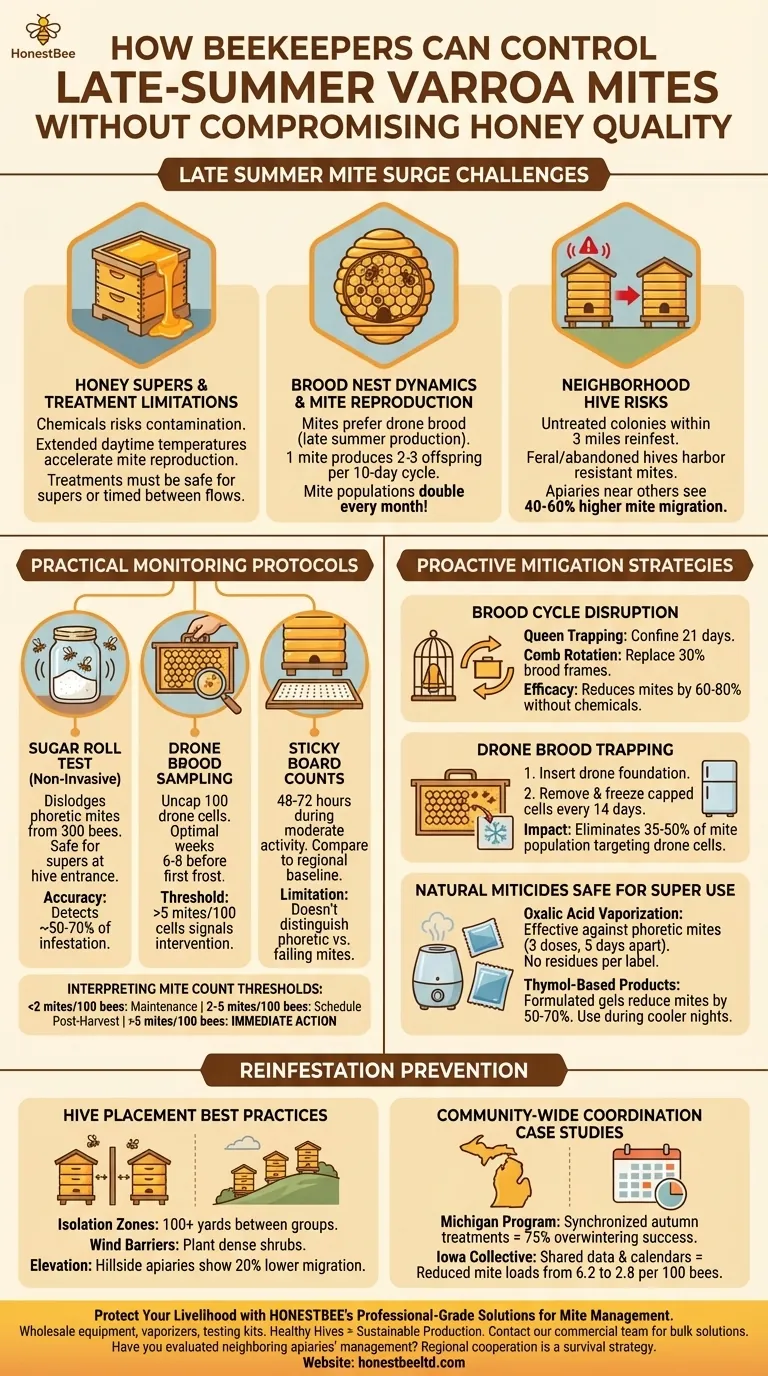
Les populations de Varroa destructor augmentent en flèche à la fin de l'été en raison de trois facteurs cumulatifs :
Hausses à miel et limites des traitements
- La plupart des acaricides chimiques ne peuvent pas être appliqués pendant la miellée en raison des risques de contamination
- Les températures diurnes prolongées accélèrent les cycles de reproduction des acariens
- Considération clé : Les traitements doivent être sans danger pour les hausses ou être programmés entre les miellées
Dynamique du couvain et reproduction des acariens
- Les acariens infestent préférentiellement le couvain de mâles, que les colonies produisent encore à la fin de l'été
- Un seul acarien peut produire 2 à 3 descendants par cycle de 10 jours dans le couvain d'ouvrières
- Fenêtre critique : Les populations d'acariens doublent chaque mois pendant la haute saison
Risques liés aux ruches du voisinage
- Les colonies non traitées dans un rayon de 5 km agissent comme des sources de réinfestation
- Les ruches sauvages et le matériel abandonné abritent souvent des acariens résistants
- Données régionales : Les ruchers situés près d'exploitations commerciales présentent des taux de migration des acariens 40 à 60 % plus élevés
Protocoles de surveillance pratiques
Méthodes d'échantillonnage non invasives pendant la miellée
-
Test au sucre glace
- Utilise du sucre glace pour déloger les acariens phorétiques de 300 abeilles
- Sans danger pour les hausses lorsqu'il est effectué à l'entrée de la ruche
- Note sur la précision : Détecte environ 50 à 70 % des niveaux d'infestation réels
-
Échantillonnage du couvain de mâles
- Le désoperculage de 100 cellules de mâles révèle le succès de la reproduction des acariens
- Optimal pendant les semaines 6 à 8 avant les premières gelées attendues
- Seuil : >5 acariens pour 100 cellules indique une intervention nécessaire
-
Comptage sur lange graissé
- Placer des langes pendant 48 à 72 heures lors des périodes d'activité modérée
- Comparer les chutes aux données de référence régionales
- Limite : Ne fait pas la distinction entre les acariens phorétiques et ceux qui tombent naturellement
Interprétation des seuils de comptage d'acariens
- <2 acariens/100 abeilles : Surveillance de maintenance uniquement
- 2-5 acariens/100 abeilles : Programmer un traitement après la récolte
- >5 acariens/100 abeilles : Nécessite une action immédiate ciblée sur le couvain
Stratégies d'atténuation proactives
Techniques de perturbation du cycle du couvain
- Emprisonnement de la reine : Confiner la reine sur 1 à 2 cadres pendant 21 jours pour créer une période sans couvain
- Rotation des cadres : Remplacer 30 % des cadres de couvain pour briser les cycles de reproduction des acariens
- Données d'efficacité : Les méthodes de perturbation réduisent la charge en acariens de 60 à 80 % sans produits chimiques
Efficacité du piégeage du couvain de mâles
- Insérer une feuille de cire à mâles dans les cadres périphériques
- Retirer et congeler les cellules operculées tous les 14 jours
- Impact : Élimine 35 à 50 % de la population d'acariens ciblant les cellules de mâles
Acaricides naturels sans danger pour les hausses
- Vaporisation d'acide oxalique
- Efficace contre les acariens phorétiques lorsqu'il est appliqué en 3 doses, espacées de 5 jours
- Ne laisse aucun résidu dans le miel lorsqu'il est utilisé selon les instructions de l'étiquette
- Produits à base de thymol
- Les gels formulés réduisent les acariens de 50 à 70 % sans contamination des rayons
- Conseil d'application : Utiliser pendant les nuits plus fraîches pour minimiser l'irritation des abeilles
Prévention de la réinfestation
Bonnes pratiques d'emplacement des ruches
- Zones d'isolement : Maintenir plus de 90 mètres entre les groupes de traitement
- Barrières contre le vent : Planter des arbustes denses pour réduire la dérive des abeilles
- Élévation : Les ruchers à flanc de colline présentent des taux de migration des acariens 20 % plus faibles
Études de cas sur la coordination à l'échelle communautaire
- Programme de l'Association des apiculteurs du Michigan
- Traitements automnaux synchronisés dans 8 comtés
- Résultat : 75 % de succès d'hivernage contre 45 % dans les zones non participantes
- Collectif de ruchers commerciaux de l'Iowa
- Partage des données de surveillance et des calendriers de traitement
- Réduction de la charge moyenne en acariens de 6,2 à 2,8 pour 100 abeilles en 3 saisons
Protégez votre gagne-pain avec les solutions professionnelles de HONESTBEE
Les apiculteurs commerciaux font confiance au matériel de gros de HONESTBEE pour une gestion des acariens évolutive. Des vaporisateurs aux kits de test, nos systèmes aident les distributeurs à équiper les ruchers avec des outils validés par la recherche — car des ruches en bonne santé signifient une production de miel durable. Contactez notre équipe commerciale pour des solutions en gros adaptées à la taille de votre exploitation.
Avez-vous évalué l'impact des calendriers de gestion des ruchers voisins sur votre pression parasitaire ? La coopération régionale n'est pas seulement une question de bon voisinage, c'est une stratégie de survie dans l'apiculture moderne.
Guide Visuel
Produits associés
- Vaporisateur d'acide oxalique 12V pour le traitement de l'acarien Varroa Outil d'apiculture pour la ruche
- Varroa Easy Check Kit de test d'acariens Contre-bocal de lavage à l'alcool
- Distributeur circulaire compact de traitement contre les acariens des abeilles
- Vaporisateur d'acide oxalique 12V pour le traitement des abeilles contre le varroa
- Distributeur d'acide formique et d'acide acétique réglable pour le traitement des acariens des abeilles
Articles associés
- Comment le traitement sans couvain libère tout le potentiel de l'acide oxalique contre le varroa
- Comment maîtriser la vaporisation d'acide oxalique pour un contrôle sûr et efficace des acariens Varroa
- Optimisation de la lutte contre le Varroa : un guide de rotation basé sur la science pour les apiculteurs
- Comment la vaporisation d'acide oxalique permet de lutter en toute sécurité contre les acariens tout en protégeant les abeilles
- How Beekeepers Can Control Varroa Mites Without Harming Their Colonies